
As the business expanded its operational scale, the number of platforms that produced data increased rapidly and became fragmented made the synthesis and synchronization of information difficult. Data fragmented in many systems causes personnel to take a long time on manual processing, from which to deflect and reduce analysis efficiency. This is why. data connoctor Becoming the key tool in the modern data system because it helps automate the entire process of passing information between the platforms and maintaining the stream of data that is streamed for business.
If you have just begun to learn about this concept, see the previous article What's Data Connector? Automated multisource data for businessTo get the platform before going deeper.
The following article will expand details of core features, performances, and categories data connoctor Commons helps you better understand the role of this tool in the business data system.
Highlights of a Data Connector
One Data Connector Good not only convert data from one place to another. It is a system designed to maintain stable, consistent, and safe data flow. Below are the core features that make this tool valuable in business.
1. The ability to connect flexiblely to multiple data sources
Data Connector quality needs to be handled well the diversity of the current source. Businesses typically use advertising platforms, CRM, ERP, financial systems, internal data storage and sales management software simultaneously.
Due to flexible connection, Data Connector takes all the fragmented data back to a place that focuses on creating a unified view, helping the business avoid fragmentation and significantly shortened the time of the synthesis of data.
2. Continuous data transfer and updates in real time
An Important Reason Data Connector More and more popular is the possibility of constant updates. The data can be synced according to the custom schedule as the date, hour or near real time.
This mechanism helps businesses to always work on the latest data instead of being moved with slow updates, thus raising the ability to make decisions and optimizing performance efficiency.
Three. Normalise and secure data quality
Data before moving to the destination system often passes through the processing layer of Data ConnectorYeah. The tool will perform standardisation tasks such as data field formats, properly structured values, misprocessing data or data missing.
The process of cleansing from the input point helps the data to be accurate and consistent, creating a solid basis for analysis and construction of the report.
Four. The ability to expand at the speed of business growth
The amount of business data to process has to be increased by the number of operations, transaction numbers, or customer scale. Data Connector Moderns are built with the ability to expand well to operate stable as data increases rapidly.
As a result of this flexibility, businesses do not take care of the blocked system, which does not occur in a state of interruption or reducing performance when heavy data is loaded.
Five. Strong data security during the entire transmission
Data usually contains sensitive information regarding clients or transactions. One Data Connector Standards need to integrate multiple secure layers including transfer code, authentication and control of user rights.
Data protection throughout the movement between systems makes businesses more confident to operate, reduce risk of leaking information and secure adherence to security policies.
How does Data Connector operate?
Process of Action Data Connector was designed to make sure that the data moved through, properly structured and did not occur. Businesses can visualize the following steps:
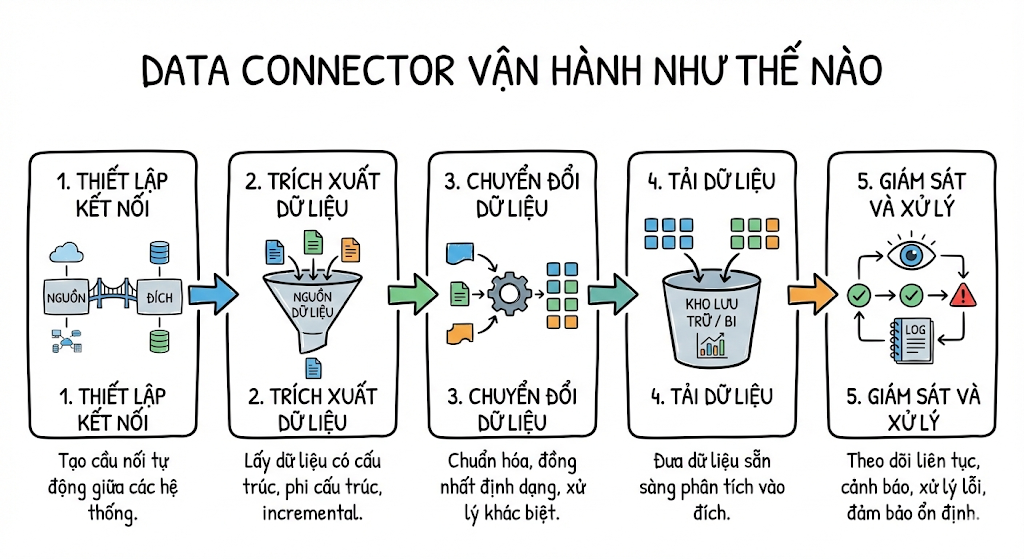
1. Set connections with source and target system
First business configuration Data Connector to link to the platforms in use. This is the bridge-making step between the source system and the data receiver, which allows the data line to move automatically without manual manipulation.
2. Export data from the source system
When the connection is complete, Data Connector Start extracting data. The tool is capable of taking structured, non-structured data or log-form data from various formats.
The extract can take place in a full or incremental method, helping optimize the speed and decompression to the source system.
Three. Convert data to match the structure of the target system
After being retrieved, the data will pass through the conversion to match the schema that the target system requires.
Data Connector Perform format standardization, uniform data type and process differences between platforms. This is a key step that ensures that the data reaches the destination with a state of readiness for analysis.
Four. Download data to archive or analysis tool
The data after the conversion will be brought into Data Warehouse, the BI or dashboard tool that business is using.
As a result of this process, the team of analysts can approach the data immediately to assess the performance of the campaign, monitor sales or monitor business indicators.
Five. Observations and processing errors during operations
Data Connector Constantly tracking data flow and noting outbreak errors. The tool can re-execut, send warnings or log details to help the engineering team quickly process.
This monitoring mechanism ensures that the system is consistently stable and uninterrupted, especially in large data environments.
Current Data Connector Types
Businesses Can Choose Many Types Data Connector It's up to the demand and structure.
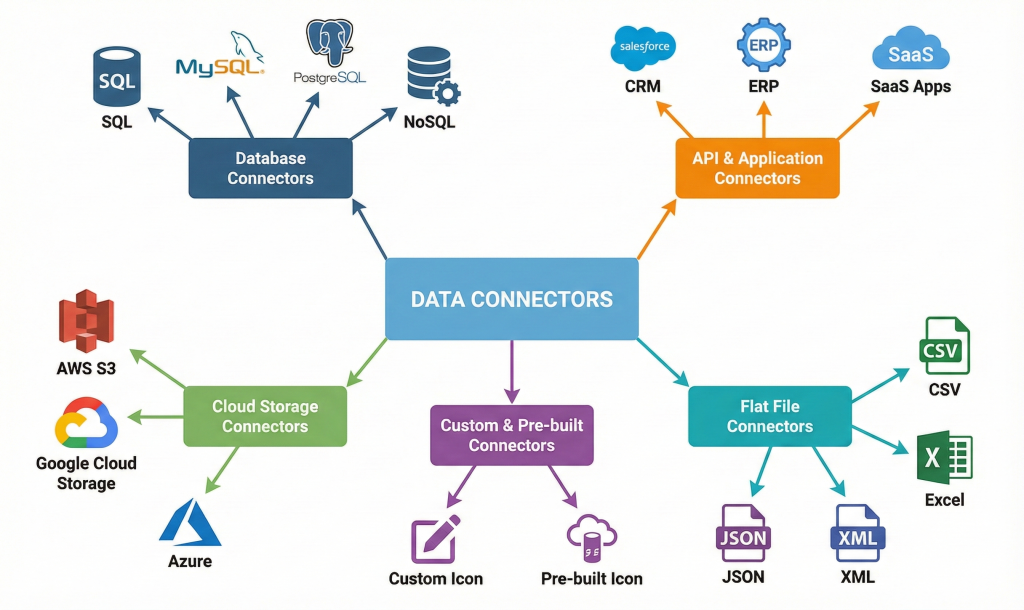
1. Database Connectors
This is the connector group that supports connection with databases such as SQL, Lindberg, PostgreSQL, NoSQL, OLLP or OLAP.
The group is often used to extract transaction data, operating data or internal analysis data.
2. API and Argyle Connectors
Connect with SaaS applications such as CRM, ERP, sales or platforms.
Data synced through API of application, making business easy to integrate external services.
Three. Cloud Storage Connectors
In accordance with the business of archived data on cloud environments such as AWS S3, Google Cloud Stoweage or Azure.
Supporting tools retrieve data from various types of physics in the Octotype system.
Four. Flat File Connectors
Support handles files such as DSV, Excel, JSON or XML.
This is a popular option in case the old system or partner only provides data through the regular file.
Five. Custom and Prebuilt Connectors
The business can use pre-built contortion or custom construction requirements for specific platforms.
The group helps optimize integrated speeds and conforms to the process of private operations.
Conclusion
Data Connector is becoming an integral component in modern data architecture. This tool enables the business to automate the data flow, secure accuracy, enhance security and create an immediate operating system. As the data is fully connected and synchronized, businesses can analyze more accurately, optimize costs and make faster decisions.
With the role of lowering core data, Data Connector It's the basis for business moving towards intelligent and sustainable operating models.

